The Floral Tropis Watercolor Elements Vector: Your Guide to Smart Creative Use
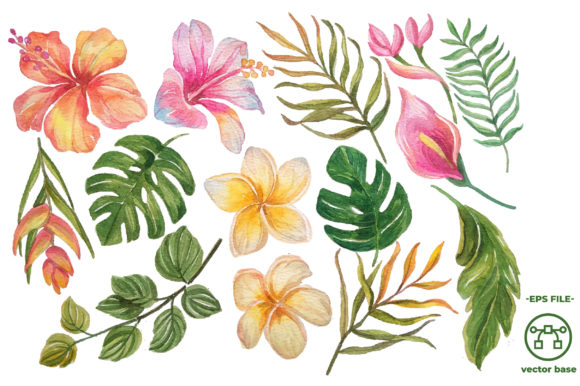
You’ve come across the Floral Tropis Watercolor Elements Vector—a set of beautifully rendered atercolor-style illustrations converted into crisp, scalable digital vectors. This isn’t just a pretty image; it’s a versatile creative asset packaged as an EPS file, compatible with Adobe Illustrator CS6 and other vector processing applications like CorelDRAW, Sketch, and Inkscape. The promise is significant: designs that won’t blur, even when blown up for large-scale prints or displays. But before you download and start using it, let’s walk through some common pitfalls and smarter approaches to ensure your project shines.
Understanding What You Actually Have
A frequent oversight is not fully grasping the difference between a true vector and a raster image pretending to be one. The Floral Tropis Watercolor Elements Vector is a legitimate vector file. The original watercolor artwork has been meticulously traced or recreated using vector paths in software like Illustrator. This means every leaf, petal, and brushstroke effect is defined by mathematical points and curves, not pixels. The benefit is infinite scalability without quality loss, but the requirement is that you need software capable of editing those paths.
Many beginners download an EPS file and try to open it directly in a simple photo editor like Photoshop. While Photoshop can import EPS files, it often rasterizes them at a default resolution, immediately locking you into a pixel-based image and negating the entire scalable advantage. A better approach is to confirm you have access to a vector application. If you don’t, free software like Inkscape is a powerful alternative. Opening the file there preserves its vector nature, allowing you to truly leverage its flexibility.
The Compatibility Check: Beyond the Label
The product description notes “base AI CS6.” This is helpful, but it’s a starting point, not an absolute limit. A common mistake is assuming newer versions of Illustrator or completely different programs won’t work. In reality, EPS is a relatively universal vector format. You should be able to open it in modern Illustrator versions, CorelDRAW, and others. However, what you should check is font compatibility and layer organization.
Sometimes, vector art uses specific fonts for textual elements within the design. If the Floral Tropis set includes any text (like floral-themed words or labels), the EPS file might embed those fonts, but upon opening in a different software, your system might substitute them if the font isn’t installed. This can subtly alter the design’s look. Before finalizing any project, inspect all elements. Also, open the file and explore its layers. Well-organized vector files often group elements logically—separate layers for different flowers, backgrounds, or accents. Understanding this structure upfront saves hours of frustration later when you want to edit or recolor a specific part.
Color Editing and Consistency
The watercolor aesthetic is defined by its soft, blended colors. When working with the Floral Tropis Watercolor Elements Vector, a tempting but poor choice is to use simple, flat fill tools to change colors, which can result in a harsh, digital look that clashes with the original painterly style. The vector paths likely include gradients or complex color blends to mimic watercolor washes. To edit colors effectively, use your vector software’s gradient editor or learn to adjust the color stops within a blend. This preserves the delicate atercolor feel.
For example, if you want to change a pink flower to a blue one, don’t just select the shape and pick a new solid blue. Instead, examine the existing color gradient. Replace the pink hue in the gradient spectrum with your desired blue tone, keeping the transparency and blend settings intact. This maintains the visual texture and ensures your modifications feel cohesive with the rest of the design.
Resolution Myths and Print Preparation
The key selling point—“will not blur even if printed in large size”—is true, but with a critical caveat: it depends on your output process. A major misunderstanding is thinking any large print is automatically perfect. While the vector file itself has no resolution limit, the final print quality depends on the printer’s capabilities and the file settings you provide.
Always communicate with your printer or check your own print settings. When sending the file, specify that it is a vector EPS. For enormous formats like wall murals or trade show banners, some printing RIPs (Raster Image Processors) prefer specific vector formats or settings. A practical step is to also provide a high-resolution PDF export of your final layout alongside the native EPS, as PDFs can encapsulate vector data reliably and are often a standard submission format. This avoids last-minute surprises where a printer’s software has a rare hiccup with a raw EPS.
Application Scope: Knowing When to Use It
The Floral Tropis Watercolor Elements Vector is versatile, but not universally optimal for every project. A common error is using it for tiny, low-resolution web icons where its intricate details become invisible. Conversely, its true power is unlocked in medium to large-scale applications. Think of wedding invitations, boutique product packaging, blog header graphics, educational poster designs, or branding materials for a creative small business.
Consider your final medium. For a website hero image, you can scale it to any screen size perfectly. For a physical product like a coffee mug or t-shirt, the vector file allows the decorator to scale the art to the exact template without jagged edges. Before committing, sketch out a few mockups. Place the vector elements into your intended layout template at the actual intended size, not just a placeholder size. This reveals how the details hold up and whether the watercolor style matches your project’s tone.
Building a Complete Design: Avoiding Isolation
Another overlooked detail is treating the vector pack as a standalone solution. The Floral Tropis set is a component, not a complete design. Its beauty is in integration. Beginners sometimes drop a single floral element onto a blank canvas and consider it done, resulting in a sparse, unfinished look.
A better approach is to use these vectors as foundational art. Combine multiple elements from the pack, overlay them with your own text in a complementary font, and perhaps add subtle textures or backgrounds. Use the vector’s scalability to create a hierarchy—larger focal flowers, smaller accent sprigs. This builds a professional composition. Remember, these elements are meant to be edited. Don’t be afraid to ungroup, recolor, and rearrange them to suit your unique vision.
The Support Advantage: Don’t Hesitate to Ask
The note, “If you have any questions about this design, please contact us,” is a valuable resource often ignored. Misunderstandings about file editing, color separation, or software issues can stall a project. Reaching out to the creator or seller for clarification is a smart, proactive step. They can often provide specific tips on how the file is structured or troubleshoot a compatibility issue you’re facing. It turns a generic download into a supported creative tool.
Before making your final decision to use the Floral Tropis Watercolor Elements Vector, do a quick audit: Do you have appropriate vector software? Is your project suited to a watercolor aesthetic? Do you understand how to edit complex vector colors? And finally, have you planned how these elements will integrate with your overall design? By answering these questions, you move from simply having a beautiful file to executing a beautiful, scalable, and professional final product. Good luck with your design—armed with this practical knowledge, you’re set to use this asset to its full, stunning potential.